 Español
How it works
Log in
Español
How it works
Log in
The flagship feature
Calls with Paco: "call my daughter", and the family at the other end
For many older people, calling is the hard part: finding the contact, getting the screen right, not cutting off. With Paco, calling is saying it: "Paco, call my daughter". No numbers, no menus, no apps. Here's how it works inside — including what it doesn't do, which matters just as much with calls.
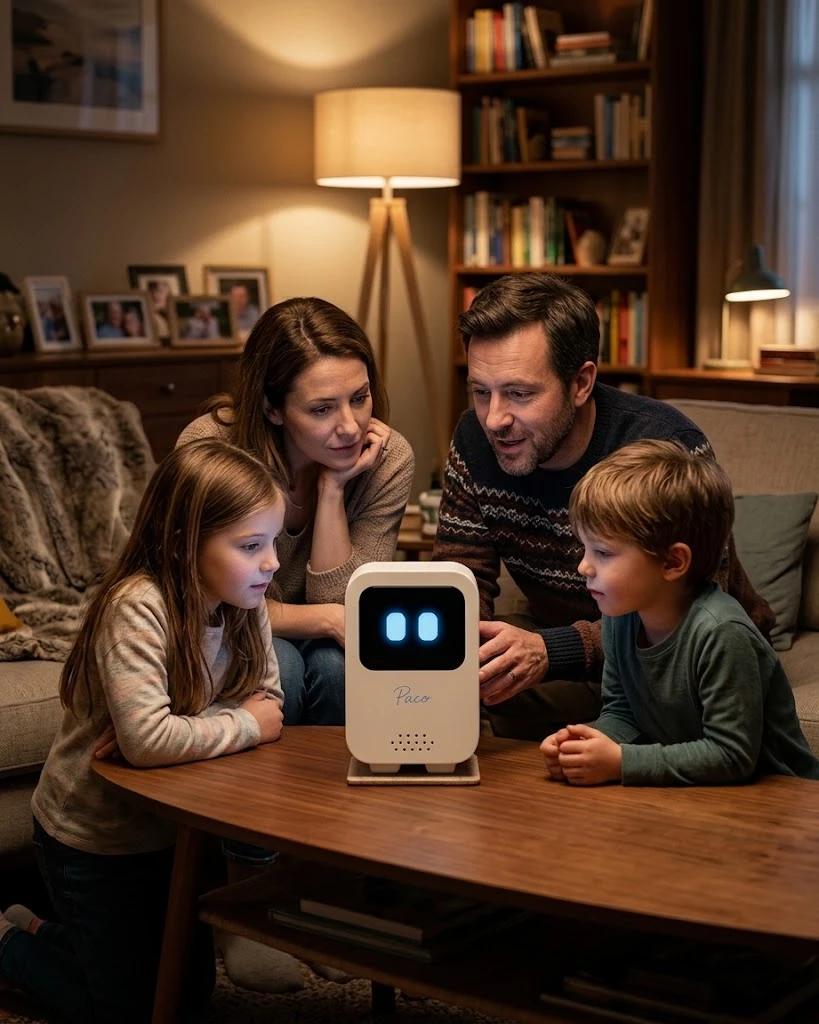
You ask by talking, like everything in Paco
You say "Paco, call Marta" and Paco gets going: it tells you it's calling, dials for you and steps aside. When Marta answers, you talk directly — your voice and hers, like an ordinary phone, but without anyone touching a button in your home.
It reaches the family two ways
If your relative doesn't have a Paco, they get an email right away: "so-and-so is calling…" and a link. They open it on their phone or computer and they're already talking to you from the browser — nothing to install, no accounts to create.
If your relative has their own Paco, the call rings directly on their robot: a ringtone, "Sonia is calling" said out loud, and a big green button to pick up. They can also answer by voice — "pick up", or "not now" — without getting off the sofa. Two Pacos calling between homes, with no phone in between.
If they don't pick up, it isn't lost in the air
An email seen two hours late isn't a dead end: the same link lets them call you back — your Paco rings and you decide at home whether to answer. And if a call between two Pacos rings and no one picks up, the owner gets a missed-call email: "Paula called you". No one is left not knowing they were thought of.
Safe by design: it only calls whom you approve
Paco's contacts are added by the family in the app (oyepaco.com/app), with a name and email. Paco cannot save a number or address dictated by voice — not even if asked. It may look like a limitation; it's the protection: no one can convince Paco, by phone or in person, to call a stranger. And for one Paco to ring another, the permission goes both ways: you both have to have each other in your contacts.
Paco dials — and steps aside
During the call, the conversation travels directly and encrypted between your two homes. Paco isn't in it: it doesn't listen, record, transcribe or learn anything you say. It's the usual frame in this house: privacy (in Spanish) isn't a setting, it's the design.
What Paco's calls aren't
They're voice calls — not video: Paco puts your family's voice in your living room, not their image. And they're not an emergency line: for emergencies there's the emergency number, and if a home needs telecare, get it — we say so in writing (in Spanish). Paco's calls are for everything else: the "how was your day?", the "I've arrived", the bit of chat a home needs.
Reserve your Paco See everything it does
You might also like: what a companion robot is · companionship for older adults.